What Is Tower Defense? A Clear Guide to the Genre
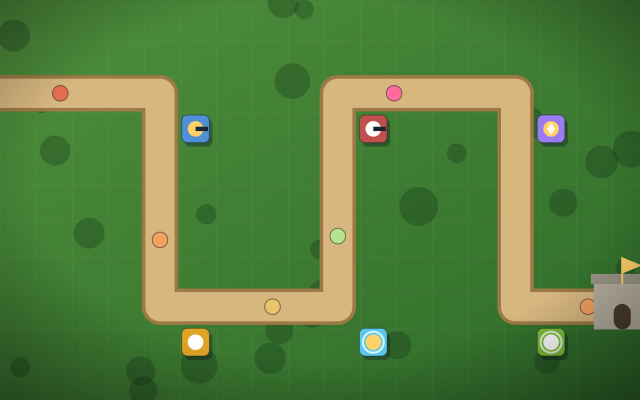
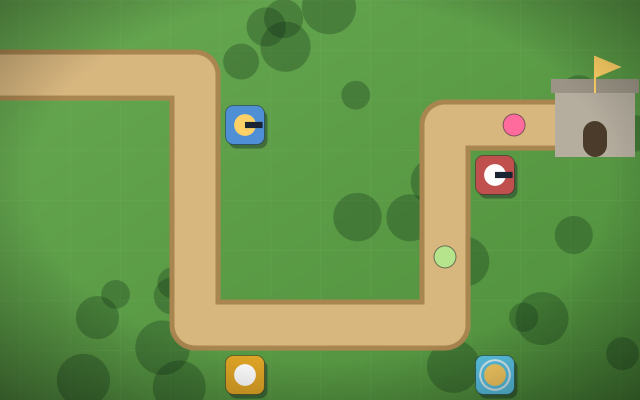
Tower defense is a strategy genre built around one simple idea: enemies travel toward something you must protect, and you stop them by building stationary defenses along the way. You never fight the enemies directly with a character (with a few exceptions we will get to). Instead you decide what to build, where to build it and when to spend your money. Everything that happens after you press Start Wave is the result of those decisions.
That is what makes the genre so satisfying. A good defense feels like a machine you designed yourself, and a lost life almost always points to a specific decision you can improve next time.
The core loop: build, defend, repeat
Almost every tower defense game follows the same rhythm:
- Build phase. You have some gold and a map. You place towers on the tiles where building is allowed, upgrade existing ones or sell towers you no longer want.
- Wave phase. A group of enemies (a wave) enters and follows a route toward your base. Your towers attack automatically whenever enemies are in range.
- Reward. Every enemy defeated pays gold, and clearing the wave pays a bonus. Enemies that reach the exit cost you lives.
- Escalation. The next wave is harder, so you spend your new gold to strengthen the defense, and the loop repeats until you clear the final wave or run out of lives.
On Tower Defense Hub, every game works this way: the next wave begins when you press Start Wave (or the N key), so you can take as long as you like to plan. Quick Defense and Endless Defense also offer an auto-start option for players who prefer a continuous flow.
The pieces every tower defense game shares
Once you recognize the building blocks, any new tower defense game becomes much easier to read. Here is how they appear in our games:
| Element | What it does | Example on this site |
|---|---|---|
| The route | The path enemies follow to the exit | The single winding road in Kingdom Defender |
| Towers | Stationary defenses that attack automatically | Archer Post, Bombard, Frost Tower and Ballista |
| Currency | Pays for building and upgrading | Gold, or Energy in Space Defense and Supplies in Zombie Defense |
| Enemies | Units with different speed, health and defenses | Footman, Scout (fast), Brute (tank), Ironclad (armored) |
| Lives | Your margin for error | Castle health 30 in Medieval Castle Defense |
| Bosses | Very tough enemies that test the whole defense | The Warlord on wave 15 of Kingdom Defender |
Enemies do not all cost the same number of lives. An enemy that reaches the exit removes lives equal to its strength, and bosses remove many at once, so letting a single boss through can hurt far more than a handful of small enemies.
Why towers need to be different from each other
If every tower did the same thing, the genre would just be a question of spending money as fast as possible. The depth comes from roles. A typical lineup includes a cheap all-rounder, a splash tower that hits groups, a slowing tower that holds enemies in place and a long-range tower that hits hard. Enemy types are designed to push against those roles: fast enemies race past slow-firing towers, and armored enemies shrug off weak hits.
Armor is a good example of how the genre rewards thinking. In our games, armor is a flat reduction per hit, and every hit still deals at least 25 % of its damage. A tower that hits for 10 against armor 8 deals only 2.5 per hit, while a tower that hits for 60 deals 52. So the right answer to an armored enemy is not "more towers" but "bigger hits" — which is exactly why Kingdom Defender gives you the armor-piercing Ballista. You can read more about this in our guide on choosing the right tower for each job.
Where the genre came from
Tower defense grew out of player creativity. Early custom maps made inside real-time strategy games, and later Flash-era browser games, popularized the format of fixed routes, waves and upgradeable towers. Because the rules are easy to learn and the sessions can be short, it fit perfectly into the browser, and it later spread to consoles, PCs and phones. Modern HTML5 technology means it runs in a browser tab again, without plugins or downloads.
The main styles you will meet
The basic loop stays the same, but games change the rules around it. The most common variations are:
- Fixed path. Enemies follow a predetermined road, and your job is to cover it well. Kingdom Defender and Quick Defense are clear examples.
- Maze building. The map is open and your towers form the walls. In Maze Defense enemies always take the shortest open route, and you lengthen that route with cheap Wall towers — but you are never allowed to block every route completely.
- Multiple lanes or converging paths. Several routes split your attention, as in Medieval Castle Defense with its 3 lanes or Crystal Defense, where two paths converge on the central crystal.
- Heroes and abilities. Hero Defense adds a controllable hero, the Warden, who moves where you tap and has abilities on cooldowns.
- Endless and boss-focused modes. Endless Defense never stops; health keeps scaling and a boss arrives every 10 waves. Boss Defense builds each of its four stages toward a unique boss.
Our guide to fixed path vs maze tower defense compares the two biggest styles in detail.
What skill looks like in tower defense
Tower defense rewards planning more than reflexes. Experienced players tend to do the same few things well:
- They look at the whole map before placing anything and find spots where one tower can cover several stretches of the route.
- They spend early gold on reliable damage so the first waves pay for later growth.
- They pair towers that help each other, such as a slow in front of a splash tower.
- They watch why an enemy leaked instead of just adding another tower anywhere.
- They use pause and speed controls deliberately: fast-forward the easy waves, pause to think when something goes wrong.
Where to start on Tower Defense Hub
If you are brand new, try Quick Defense: it has 10 short waves, three towers (Bolt, Splash and Frost), big touch targets and sessions of roughly 3–7 minutes. When you want a full campaign with more tower choice, move on to Kingdom Defender, an easy game with one winding path and 15 waves ending in a boss. Both appear in our classic tower defense collection.
From there, our explanation of how tower defense games work goes through the mechanics in detail, and the beginner strategy guide turns them into a practical plan for your first games.