Zombie Defense
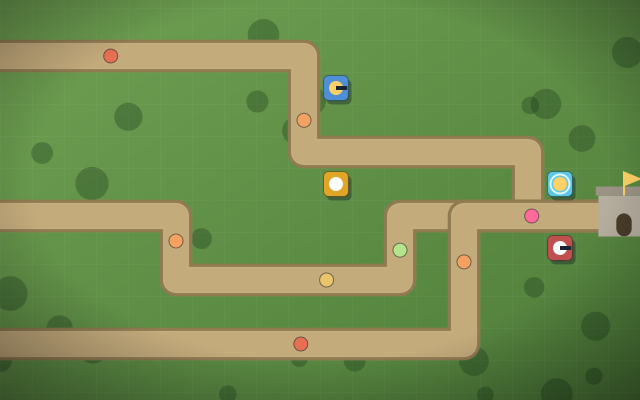
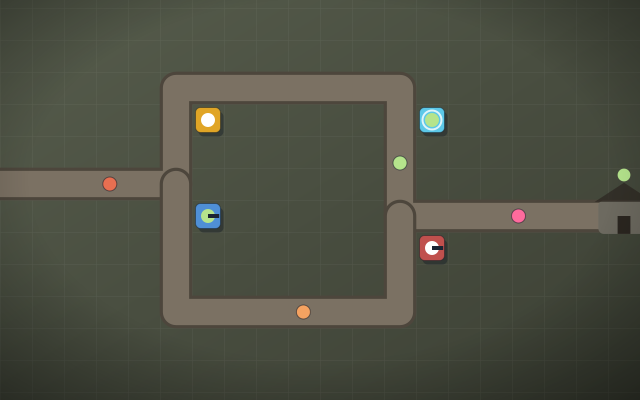
The horde splits at a fork in the road. Rifles, shotguns, glue and explosives keep the safe zone standing.
Military tower defense puts a fortified position at the centre of the map and brings the attack to it from more than one direction. The theme is about holding ground: walls, siege engines, outposts and supply lines. In game terms, that means multiple lanes or converging paths, enemies built to hurt your base in particular, and conditions that change how well your towers can see.
Three games fit here. Medieval Castle Defense defends a hilltop castle across three lanes. Desert Defense protects an outpost from three converging paths through day, night and sandstorms. Zombie Defense guards a ruined town's safe zone on a forking path. The settings are fiction and the terminology is game language only; our disclaimer says more about that.
The horde splits at a fork in the road. Rifles, shotguns, glue and explosives keep the safe zone standing.
An army attacks along three roads at once. Ballistas, cannons and mages must hold every lane for 16 waves.
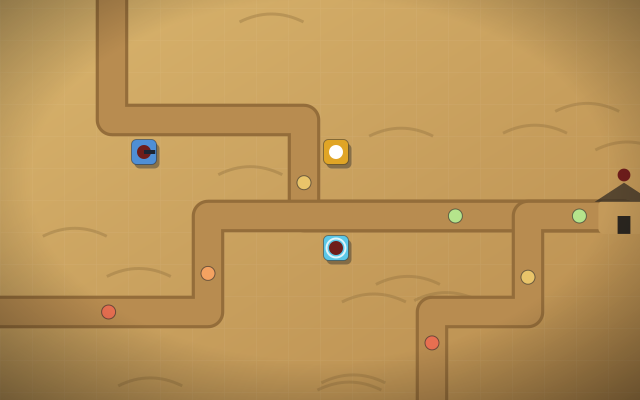
Three paths converge on your outpost. Night and sandstorms cut your range unless a Radar Tower covers you.
Most games in this collection share one challenge that single-path games do not: the enemy does not arrive in one line. When attackers come down several routes, every tower you place is a choice about which front to favour. Build everything on one lane and another lane leaks. Spread evenly and no lane is strong enough for the heavy waves. The skill is finding where coverage overlaps, then deciding how much to trust each lane on its own.
Medieval Castle Defense has three lanes and a castle with 30 health. Your towers are the Archer, the Ballista (anti-armour), the Cannon (splash) and the Mage (chain lightning, each jump dealing 75 % of the previous). Soldiers are the baseline, Raiders are fast, Knights are armoured, and the Siege Ram is a tank that deals heavy damage to the castle if it reaches the gate. Because of that, the Siege Ram deserves more attention than its slow pace suggests: a single one getting through can cost more health than a crowd of Soldiers. The Siege Tower boss arrives on wave 16, the last wave.
Desert Defense is rated hard and is really a game about range. Three paths converge on the outpost, and you defend it with the Sniper, Cannon, Rapid Fire and Radar. At night towers lose 15 % of their range unless a Radar covers them, and sandstorm waves cut the range of every non-radar tower by 30 % while making enemies slightly faster. The Radar is a support tower that adds damage and restores range to the towers around it. Radar boosts do not stack with each other, so what matters is how many towers each Radar covers, not how many Radars cover one tower.
Zombie Defense has one path with a fork and a base with only 20 health. The fork creates a smaller version of the same multi-front problem. See the zombie defense page for how to deal with Bloaters and their Crawlers.
These games suit players who like juggling several priorities at once and who enjoy the tension of a gate or outpost that can only take so much. Castle Defense is the most approachable of the three; Desert Defense is the one to try when you want a hard puzzle about coverage.
How lives are lost, which enemies cost the most, and how to build layered defences and a last line that keep your base safe.
Where to put each tower and why: bends, merges, slow-then-splash ordering, sniper spots, support clusters and map-specific tricks.
How armor reduces damage, with the formula worked through, and the towers and tactics that beat armored enemies in our games.
A practical framework for building defenses that hold: cover the core roles, layer towers so they help each other, and adapt to each wave's threats.
No. The castles, outposts and siege engines are fiction, and the advice here applies only to our games. It is not military, security or real-world defense guidance.
The Radar is a support tower that adds damage and restores range to towers inside its radius. That protects them from the night range penalty and from sandstorms.
It is a tank that deals heavy damage to the castle if it reaches the gate. With 30 castle health, letting even one through can undo several clean waves.
Hold the safe zone against walkers, runners, bloaters and the Abomination.
1 gameExtra systems to plan around: mazes, element combos, branch upgrades, terrain and bosses.
8 gamesOutlast the pressure: scaling waves, hordes, boss gauntlets and a jungle under siege.
4 games