How to Handle Fast Enemies in Tower Defense
Fast enemies are rarely the toughest units in a wave, but they are often the ones that cost you lives. A defense tuned for a steady stream of average units can look perfect until a group of runners sprints through it. The problem is not their health; it is time. A tower can only hurt an enemy while it is in range, and a fast enemy leaves that range before the tower has fired enough shots.
This guide explains how to think about speed and gives concrete counters, with examples from the fast units in our games.
Know the fast units
Most of our games include at least one unit built around speed:
- Scout in Kingdom Defender
- Dire Wolf in Crystal Defense
- Runner in Zombie Defense
- Raider in Medieval Castle Defense
- Fast Bot in Robot Defense
- Gale Sprite in Elemental Defense, which is fast but weak to ice
Some games also speed enemies up temporarily. Robot Defense has an Overclock wave event that makes enemies faster, Desert Defense's sandstorm waves make enemies slightly faster while cutting range for towers not covered by a Radar, and one of the Daily Tower Defense Challenge rules is fast enemies.
Think in time-in-range, not health
The damage a tower deals to an enemy is roughly its damage per second multiplied by how long the enemy stays inside its range. An enemy moving twice as fast gets half the time and therefore takes about half the damage from each tower it passes. You can fix that in three ways: make the enemy slower, make the stretch of path covered by your towers longer, or make your towers prioritise the fast units. The strongest defenses do all three.
Slow them first
Slows are the most direct answer to speed. Examples include the Frost Tower, Cryo, Frost, Ice, Glue Tower and Rune Stone, plus abilities such as Frost Nova in Crystal Defense and the Warden's Frost Field in Hero Defense. Place your slow where enemies enter your main damage zone so that everything behind it benefits from the extra time.
Two rules shape how you use slows against runners:
- Slows do not stack. Only the strongest slow on an enemy applies, so two slow towers on the same stretch add little. Spread them along the path or set the second to target differently.
- Slows work on fast units exactly as on slow ones, as a percentage of speed. A fast unit that is slowed is still faster than a slowed normal unit, so slow alone is rarely enough; combine it with coverage.
In Jungle Defense, mud tiles slow enemies by 35 %. Build your damage around mud stretches so the terrain works for you without costing gold.
Cover a long stretch of path
Where you place towers matters more against fast enemies than against anything else. Good spots:
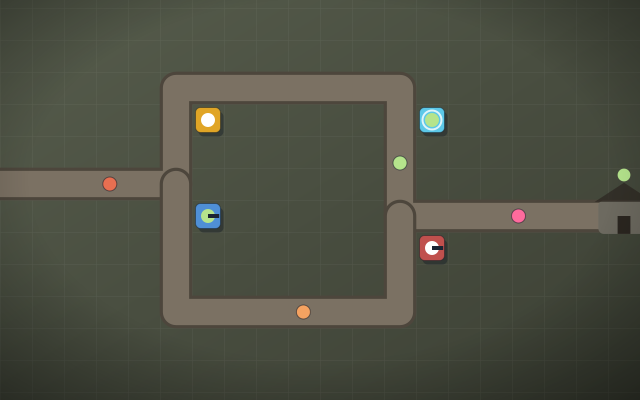
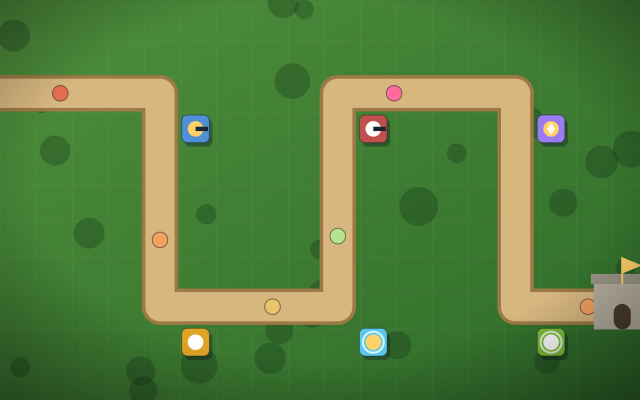
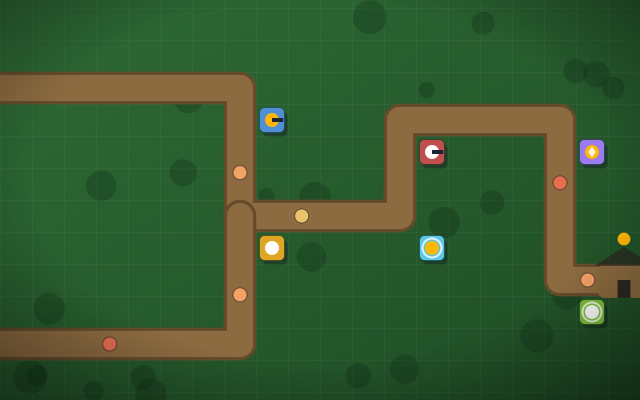
- Inside bends and U-turns. A tower on the inside of a curve covers the path on both sides, so enemies pass through its range twice or for much longer.
- Long straight stretches for long-range towers such as the Ballista, Sniper or Longshot.
- Late in the route as a safety net. Keep at least one tower close to the exit for anything that slips through.
Avoid putting all your damage at the very start. Fast units in the front of a wave reach the exit before the slower units behind them, and if your whole defense is near the entrance, nothing is left to catch them.
Use the Fastest targeting mode
Every attacking tower can be set to Fastest, which picks the fastest-moving enemy in range. One or two towers on Fastest, especially late along the path, act as dedicated runner catchers. The rest of your towers can stay on First. Press T on a selected tower to cycle modes. Our tower targeting strategies guide covers the other modes.
Choose the right kind of damage
Against fast units the problem is time rather than toughness, so what matters is that damage lands before they leave range. Useful traits:
- Instant or continuous hits. The Laser in Space Defense fires a continuous beam, so it never wastes time on a slow projectile.
- Homing projectiles. Missile towers home in on targets.
- Chain damage. Magic, Mage, Tesla and Lightning towers jump between nearby enemies, catching runners that are mixed into a group.
- Area around the tower. The Pulse tower in Robot Defense damages everything around itself, and the Shotgun in Zombie Defense has a short-range spread. Both are strong at choke points where runners must pass close by.
Special cases: mazes and abilities
Mazes: make the path longer
In Maze Defense you control the route. Enemies always take the shortest open path, and after every placement that path is recalculated. Cheap Walls can force a longer, zig-zagging route, so fast enemies spend much more time inside your towers' ranges. You cannot fully block every route, and you cannot build on a tile an enemy is standing on or entering, so shape the maze during the build phase. For the details, see pathfinding in maze defense.
Hero and ability games
If a game gives you active tools, save them for fast waves. In Hero Defense, move the Warden to where runners are leaking and use Frost Field to slow the group. Rally heals the hero and restores 2 lives if some already got through. In Crystal Defense, Frost Nova slows everything at once, which is ideal when a pack of Dire Wolves arrives.
Checklist for a fast wave
- At least one slow placed at the entry to your main damage zone.
- Towers on the inside of bends, not just on straights.
- One or two towers on Fastest near the end of the route.
- Abilities ready, if the game has them.
- Watch the first fast wave at 1× speed to see exactly where they break through.
Zombie Defense is a good test: Runners arrive alongside slow Walkers and tanky Bloaters, and with base health of only 20, every leak hurts.